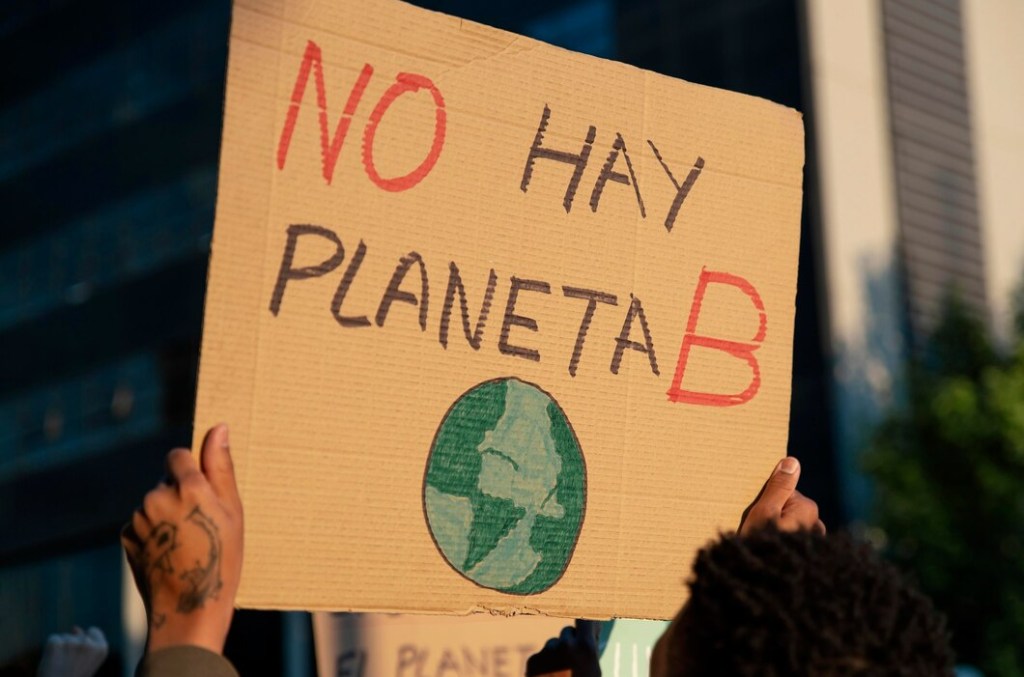
We have about 7 years left to make a difference. That is the key takeaway, which is anything but new, reiterated by the most recent UN (IPCC) climate report.
Dire warnings about climate change have become a staple of our every day – we know it, we live it, we suffer from it. The total bill of climate-related disasters is $4.3 trillion and 2022 was a record-breaking year in terms of number of extreme weather events – yet, every time we hear about a new report on the topic the reaction is either:
OR
*No dig to Obama who left a “bold but fragile” climate legacy
Side note #1: Facts rarely change minds – by themselves. The perception of many of these reports has a lot to do with our psychology as humans, and how we learn and integrate information. We are notoriously crappy at dealing with facts, especially complex ones; however, many times, stories engage the audience more successfully than the mere presentation of facts, and a growing body of scientific evidence suggests that our brains literally synchronize with that of the storyteller when we listen in – making the successful integration of information that much more likely. It’s no wonder then that scientific reports fly over our heads, despite the incredible research value they provide.
Side note #2: Also just read the best book on the topic of how and why we think the way we do written by the founding father of behavioral economics, Daniel Kahneman – and why our brains are wired to think fast to save us, but we need to also think slow to evolve.
Well, anyways, this one is deadly serious. The window of opportunity we have to not overshoot the Paris Climate Agreement goal and to not shoot ourselves in the foot is rapidly closing. In fact, we have about 7 years left – that is, until about 2030 to limit global warming to 1.5 degrees Celsius and avoid a catastrophic future for us, our children, and our planet.
Why 7 years? Because climate is changing not only based on our current actions – but also on past emission levels, which led us to the climate crisis that exists today. However, this doesn’t mean we shouldn’t do anything – on the contrary. It is actions that are taken today which will decide climate change, per a recent Nature article:
(…) Future warming is governed primarily by future emissions rather than by past emissions, and thus society is not geophysically committed to exceeding key global warming levels before reaching them.
Dvorak, Armour, Frierson, Proistosescu, Baker, Smith, “Estimating the timing of geophysical commitment to 1.5 and 2.0°C of global warming”, Nature
Back up, what?!
In plain language for dummies like me: The world right now is like an oven, that is pre-set to pre-heat to a certain temperature (our actions hit the “start” button and our current actions keep it pressed). What we do right now – cutting carbon emissions, managing aerosols, and limiting greenhouse gas methane – can impact the heating process and reduce (ideally) or limit the oven’s temperature that is slowly building up and getting us closer to the pre-set level. It’s like cutting the electricity (kind of like what happened during the COVID-19 lockdown globally), opening the door to the oven, or I guess adding ice on a tray inside it.
However, the longer we take to act, the less ambitious we are, the more limited our efforts – the higher the chances that we reach the pre-set temperature, and we stay at it for a very long time before things literally cool off. Per CNN:
Even if the world cut emissions to zero today, there would still be a 42% chance of hitting 1.5 degrees Celsius of warming above pre-industrial levels within a decade. That probability rises to 66% if the world waits until 2029 to reach zero emissions. (…) If the world emitted nothing today, there is only a 2% chance of breaching the higher, more severe, 2 degrees Celsius warming threshold. But that too increases to much more likely than not — 66% — if the world waits another 35 years before hitting zero emissions.
Rachel Ramirez, CNN
That’s kind of the problem though – we are nowhere near where we need to be, despite pledges from most countries.
Depressing graph A

Source: Climate Action Tracker, Temperatures, Addressing Global Warming
Depressing quotes B
To keep global warming to no more than 1.5°C – as called for in the Paris Agreement – emissions need to be reduced by 45% by 2030 and reach net zero by 2050.
United Nations
As it stands right now, we are on track for 2.4-2.6 C warming by the end of the century.
United Nations
Depressing overview C

Source: Climate Action Tracker, Country Overview
Do you want to hear some good news though?
We apparently have the technology we need to fight back. Per the United Nations Framework Convention on Climate Change (UNFCC) we have “options in all sectors to at least halve emissions by 2030” – what we lack, however, is political will to take ambitious action.
Part of the problem, I think, is what Kyle Paoletta described in Harper’s Magazine as the disappearing doomsday: the shift in how we cover climate change, from catastrophic narratives to cautious optimism. As he puts it :
It’s not quite as bad as you once imagined, but it is worse than you’ve lately been led to believe.
Kyle Paoletta, Harper’s Magazine
It’s hard to strike a balance between sharing facts, resisting fatalism, not playing favoritism, and offering clear findings that can be actioned. And while this is a complex topic and I am merely a keen observer, I do think there’s something to be said about using a doomsday clock – but for action. Instead of focusing on effects that may take place, focus instead on the window for action we have left.
In that view, the question is not how the world may look like in 2050 or 2100, as important as it is – we know our Earth System will be in danger, many people will suffer, our economies will be fundamentally changed, and conflict can be exacerbated with every 0.5 degree temperature increases. Rather, the question is: how much time do we have to act and what can we do now so that 2050 and 2100 looks different?
Want to join me in this crazy uncharted journey? Sign up below.
Photo: Image by Freepik
 The Overview Affect
Leave a comment