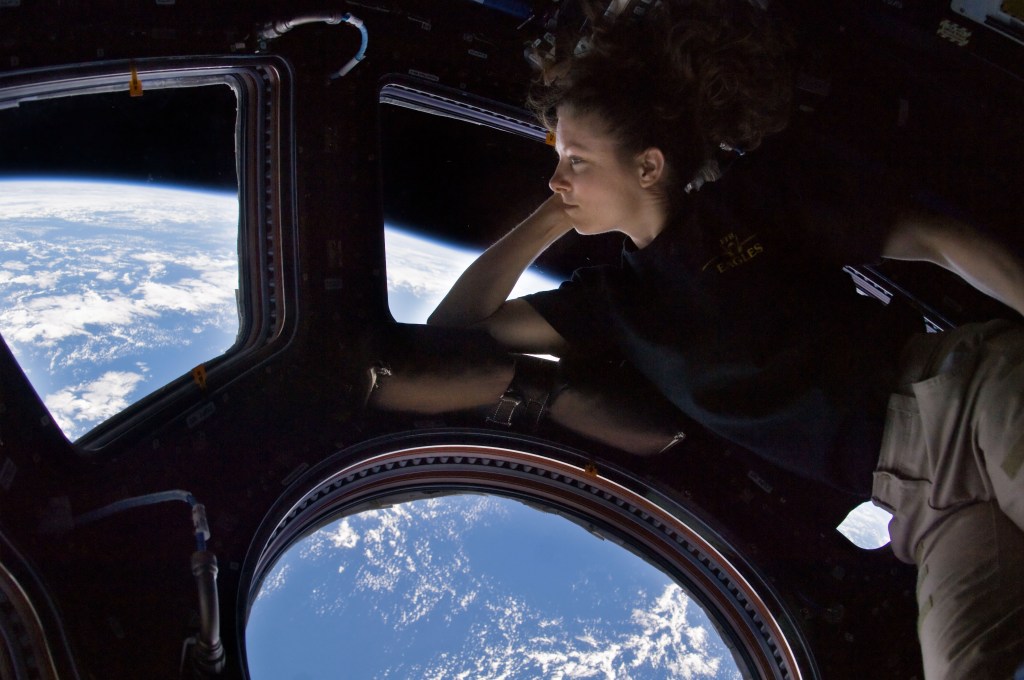
I love the reaction someone gets the first time I tell them about the “the overview effect”. It’s such an intuitive, and simple, and powerful idea, like one of those single-word German concepts that explains a whole mumble jumble of feelings in one fell swoop. Once it clicks, the person’s face is illuminated, like the light bulb just got turned on. I live for that smile and raised eyebrows.
I’ve been thinking about this concept a lot recently, and the reaction it elicits, so much so that it led me to start a blog. Allow me to explain.
The “overview effect” is a cognitive shift, an intellectual and emotional revelation, that some astronauts have reported feeling while looking back at Earth, at our Pale Blue Dot, from the dark vastness of space. It’s, concomitantly: a sense of unity; a visceral experience of being alive; and a marveling at our fragility and beauty. A whole lotta feelings there, but don’t take my word for it, check out this super awesome video about it.
What was intriguing to me, though, was how this one individual revelation could turn one’s entire internal (and social) system upside down. How viewing the Earth from space, literally leaving its known confines and stepping out into the void, not only provided a better look at the universe – but also a better look at ourselves. Astronauts talked about how it impacted their view on human-drawn borders on Earth, on the environment and sustainability, and more. The paradox of having to leave home just to better understand home is profound.
When we originally went to the moon, our total focus was on the moon. We weren’t thinking abut looking back on Earth. But now that we’ve done it, it may have well been the most important reason we went.
David Beaver
I find this overview effect, this idea of needing to zoom out to be able to fully zoom in an incredibly powerful metaphor for what our current world needs to rise above the grind of the day. From a policy perspective (which is what I do), the need is dire: despite imminent warnings of the irreversibility of climate change and surpassing the 1.5 Celsius degree limit “in the near term”, we continue to steal from tomorrow to muddle through today; for ever $1 dollar invested in infrastructure resilience, $4 result in benefit, yet a resilience-based approach is rarely baked in our policies; and finally, we are too often guilty of neglecting to understand that unaddressed historical injustices can bleed into the future, investing in protecting ourselves only once the danger is imminent, or failing to share what we have despite the fact that lack of cooperation is coming back to bite us in the butt. These are just a few examples, that we may pick up in this blog, but the list can go on and on.
We’re missing the vehicle – the space shuttle, the mission, the Moon – that can allow us to see things differently. So naturally, like any slightly obsessive compulsive nerd, I became obsessed with figuring out how to find it, bottle up the a-ha moment on it, and translate it into our current geopolitical system.
So here are a few questions that bug me as far as far as this state of affairs is concerned, that may or may not be covered in this blog at a certain point depending on my whims:
- What are the policy moonshot ideas (especially in international security), the equivalent of literally going to the Moon or creating/being in the ISS, that are so important and forward-looking that they force us to step out there beyond the known and reimagine the possible?
- Which one of those ideas are revolutionary, while at the same ideally can give us a new perspective on ourselves?
- What does change look like if we were to indeed to have that a-ha moment looking forward that allows this ability to look back?
But the trouble is though that this is not enough, and I want to go further.
In the video above, and most descriptions of the overview effect, the story stops with the person experiencing the epiphany. Despite the clarity the moment provides, the link breaks when it comes to transforming it into action. The astronauts’ revelation is, too often, individual – hard to share with others who have not been to space, difficult to scale, and maybe suffocated by the systems on Earth once they return from their journey. And that’s the missing puzzle piece I am after.
Side note #1: There’s a great book about what a unique and sometimes lonely experience it can be to have gone where no other human has been before save for 12 of your peers. Whew/yikes?!
- So then the fourth, and maybe the most important question, is how we go from the overview effect to the overview affect. Not a typo, dear readers. Here’s what Merriam Webster has to say ’bout that:
Affect (Verb). to act on or change someone or something.
Merriam Webster
Effect (Noun). a change that results when something is done or happens.
You get what I’m not so subtly aiming for. How do we turn the revelation of the overview into action, and go from a passive experiencing of change to creating it? When we do find them, rare and breath-taking, these big picture ideas, how can they be implemented? Where have they worked, what needs to happen, and what kind of change can they elicit? Ultimately, how to work together to overcome some of the challenges facing our planet?
This is pretty lofty …so let’s bring it back to Earth 😉 and put it in more think-tanky terms.
What this blog is:
- a legit* analytical effort, mostly** catalyzed by a strategic foresight methodology but also broader policy discussions, in search of “moonshot”, forward-looking or big picture ideas in internal security
- an enthusiastically partial view – i.e. one that focuses on research, policies, frameworks, strategies, tools, apps, people, communities, movements, that can foster global cooperation, prevent conflict, and minimize national security threats
- it humbly tries to offer a human-centered approach, to the extent that big picture ideas can do that, meaning it tries to apply a human security lens where possible or at least draw out the individual stories from the crowd;
- ultimately, it wants to become an action-oriented call, with ideas available for use.
* I have/love citations!
** What I find interesting also counts 🙂
What this blog is NOT:
- a structured, linear, non-ranty place, because that’s not how my brain works. The depths of midnight creativity may take us from lofty Carl Sagan references to RPDR gifs. So there! 🙂

Using the overview affect as a concept can be a powerful tool: for revelations, rethinking, reform.
This idea…is key to our survival. We have to start acting as one species with one destiny, we’re not going to survive if we don’t do that. (…)
David Loy, philosopher
The ability to understand the visible and invisible threads connecting our geopolitical system, and understanding how we can shift the narrative to focus on forward-looking, policy solutions that can build, not destroy; protect, not undermine; sustain, not exploit; connect, not divide. In the words of someone who has seen what this is all about:
It’s not just fixing an economic or political system, it’s a basic worldview, a basic understanding of who we are that’s at stake. And a part of that is to come up with a new story, a new picture, a new way to approach this, and to shift our behaviors in such a way that it leads to a sustainable approach to our civilization as opposed to a destructive approach.
Edgar Mitchell, Apollo astronaut
So let’s start here.
I have no idea where this writing adventure will take me, or how long it will go on. But if you’d like to find out, join me on my shuttle to space.
Want to join me in this crazy uncharted journey? Sign up below.
Photo: NASA Astronaut Tracy Caldwell Dyson, Expedition 24 flight engineer, looks through a window in the cupola of the International Space Station. Source: Smithsonian Institute, National Air and Space Museum
 The Overview Affect
Leave a comment